Battery backup for a refrigerator: plan for 24 hours
A fridge full of food is a good reason to plan ahead. Before you buy a large battery, find out how much energy your refrigerator uses in a day. That measurement does more for your shopping list than the size of the fridge or a promise on a box.
Where to start
Measure a full day of refrigerator use, allow for battery losses, then check running and startup power separately. The examples below need roughly 1.1, 1.9, or 2.8 kWh of nominal storage, depending on the measured load.
Start with one refrigerator and one full day
Give the battery a specific job: keep this refrigerator running for 24 hours, starting with a full charge and no help from solar. Leave the toaster, kettle, and other appliances out of the first calculation. You can add them later and see what they cost in stored energy.
The number you need is the fridge’s daily energy use in watt-hours (Wh). A reading of 1.2 kilowatt-hours (kWh) means 1,200 Wh. The watts printed on the appliance label describe an electrical rating; multiplying that number by 24 usually misses the way a refrigerator cycles.
If you already own a suitable plug-in energy meter, use it. Otherwise, a Kill A Watt P4400 is one option. Check its permitted voltage, current, and appliance load before connecting it. Our measurement guide explains which reading to record.
Measure a day that looks like your day
Record accumulated energy over at least a representative 24-hour period, using the fridge normally. Write down the room conditions and any unusual use. More than one day can give you a better picture of cycling and defrost behavior. A hot kitchen or repeated door opening can make a gentler test a poor guide to an actual outage.
If you cannot measure yet, the annual kWh figure on the refrigerator’s EnergyGuide label can give a rough starting estimate: divide by 365, then multiply by 1,000 for Wh per day. It is a standardized average. Replace it with a measurement when possible, and keep running and starting watts as separate checks.
Turn daily energy into a battery target
For these examples, we allow 85% conversion efficiency, 8 W of battery-side inverter idle draw for the full 24 hours, and a 20% extra-capacity margin. These are adjustable planning assumptions, rather than measured performance of any model below.
A fridge using 1,200 Wh over a day gives this calculation: (1,200 ÷ 0.85 + 8 × 24) × 1.20 = about 1,925 Wh of nominal battery capacity. That is why a battery labeled 1,200 Wh would fall short of this particular plan even before checking its output.
Scroll sideways to see the full table.
| Measured fridge energy | Calculated battery target | Model to compare |
|---|---|---|
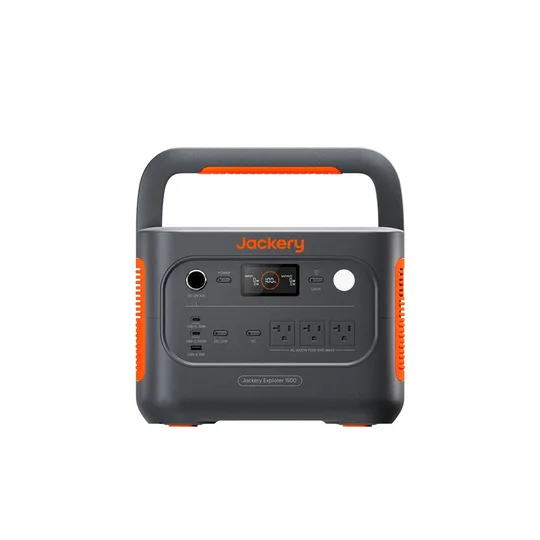
| 600 Wh per day | 1,078 Wh | Jackery Explorer 1500 v2 · 1,536 Wh |
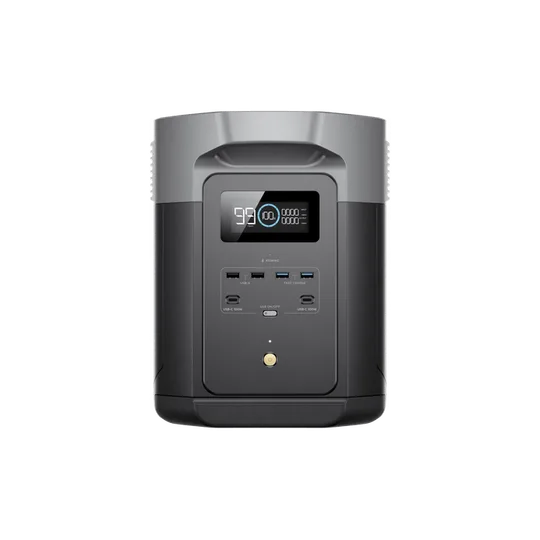
| 1,200 Wh per day | 1,925 Wh | EcoFlow DELTA 2 Max · 2,048 Wh |
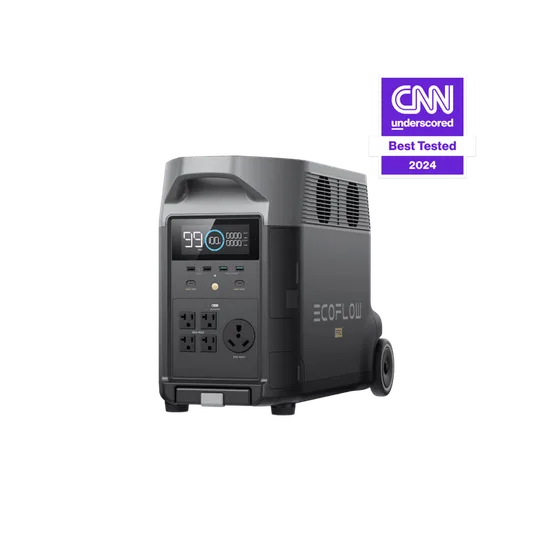
| 1,800 Wh per day | 2,772 Wh | EcoFlow DELTA Pro · 3,600 Wh |
Targets are rounded up to the next whole Wh. The three daily-use figures are examples, not a range that every fridge falls within. Each listed battery clears its row’s capacity target; that alone does not confirm it can start your refrigerator.
Choose the size that solves your problem
Jackery Explorer 1500 v2: with 1,536 Wh of storage and 2,000 W continuous AC output, it has enough nominal storage for the 600 Wh example. It does not meet the 1,925 Wh target in the middle row. If your measurement lands near that higher figure, the smaller station is the wrong compromise for a full-day, battery-only plan.
EcoFlow DELTA 2 Max: its 2,048 Wh capacity and 2,400 W continuous output make it worth comparing for the 1,200 Wh example. There is only about 123 Wh above that example’s target, which already includes the stated margin. Add another load or change the assumptions and you may need more storage.
EcoFlow DELTA Pro: its 3,600 Wh capacity and 3,600 W continuous output clear the larger example’s capacity target. Before choosing it, work out where it will sit and how you will move it. Extra capacity is useful only if the complete setup fits your home and is practical to use.
Choose between these storage sizes using your measurements and the space you have at home. Compare the three models, then check the exact model and package before buying.
Check the compressor start before ordering
Energy tells you how long the plan might last. Power tells you whether the fridge can run at all. Check the refrigerator’s running requirement against the station’s normal continuous AC rating, then check startup demand against the documented surge capability and duration.
A daily average of 50 W does not mean the compressor only needs 50 W while running. An ordinary energy meter may also miss the brief startup peak. Ask the appliance manufacturer for the requirement or use suitable measurement equipment. If other devices share the battery, include them in the overlap check. This startup example shows why.
Check AC sleep or automatic-shutoff settings too. You need the output to remain available between compressor cycles. Follow the station’s instructions, and try the real combination under supervision before relying on it. A successful calculation cannot establish transfer behavior or appliance compatibility.
Buy the small essentials before the optional extras
Keep an appliance thermometer in the refrigerator; the Taylor 3507FS is one option. Temperature and elapsed time matter more than the battery’s remaining-percentage display when deciding what food to keep.
You can skip an expansion battery if the standalone station already meets your verified plan. You can also postpone solar until you have worked through the battery-only case. A panel needs compatible inputs and a usable place in the sun, and storm conditions may give you little useful charging. Read the solar planning guide before treating it as part of your runtime.
Plan the cable route and the station’s dry, ventilated location before delivery. Keep walkways clear and follow the equipment instructions. This guide covers a refrigerator plugged into a suitable station, without changes to household wiring.
Have a food plan if the battery stops
Keep the refrigerator door closed as much as possible. Without power or another adequate cold source, a closed refrigerator generally protects food for about four hours. A full freezer holds its temperature for about 48 hours, or about 24 hours when half full, with its door kept closed.
Keep the refrigerator at 40°F or below. Discard refrigerated perishables after four hours without power or an adequate cold source; also follow the rules for food that has warmed above 40°F. Restoring power does not make spoiled food safe. Do not taste food to test it. Use our food-safety guide for the temperature and timing decisions, and keep a few meals that do not need cooking available.
Put your own numbers into the plan
Open the 24-hour refrigerator starter plan and edit the refrigerator entry. Use running watts and enough active hours to represent your measured daily Wh, then check the startup value separately. For example, 150 W for eight active hours represents 1,200 Wh across a 24-hour outage. It does not mean you should manually switch the fridge on for eight hours.
Keep the measurement, settings, and cable arrangement with your plan. If you add a router or lights, recalculate before shopping. The useful outcome is a setup you have checked with your own refrigerator and know how to use when the power stops.
Common questions
Will a 2,000 Wh battery run a refrigerator for 24 hours?
It depends on measured daily energy use, battery losses, idle draw, and output compatibility. The 1,200 Wh-per-day example here needs about 1,925 Wh of nominal storage with the stated assumptions. A higher-use fridge may need more. Check startup power separately.
Can I use the refrigerator label wattage to choose the battery?
The label helps with electrical requirements, but a full-day energy measurement is more useful for runtime because the compressor cycles. Use accumulated Wh or kWh for energy, and check running and starting power separately.
Should I add a solar panel to make the battery last a day?
Work through the battery-only plan first. Solar collection depends on weather, placement, and compatible equipment. Treat recharging as an additional scenario rather than guaranteed energy during an outage.
Find the battery size for your refrigerator.
Start with 24 hours, then replace the example wattage, active hours, and startup power with your own appliance information.
Open the 24-hour fridge plan